Museum Pedestals
Crafted for durability and refined aesthetics. Available in Step, Groove, or Flat top styles with optional acrylic vitrines.
Drag to rotate
Packing
Capacity — lb·—
- Weight rating (centered object)
- ≈ lb
- Limited by
- Assumes the object bears on about half the top in each direction — ″ × ″ on this size, centered.
- Top sag is capped at 1/360 of the span — an Upland standard, so displays read flat and vitrines sit true.
- The lower frame and leveler feet are load-tested in our shop and rated with a 2× margin — an Upland standard — after subtracting the pedestal's own weight.
ƒ
What this checks
Three checks; the lowest governs the rating. (1) The lower frame + leveler feet, rated empirically from shop load testing. (2) L/360 center sag of the top panel. (3) Bending stress of the top panel. The centered object is assumed to bear on a rectangle half the top's width and depth (a quarter of its area — a 44″ × 44″ top carries a 22″ × 22″ patch). Practical estimate, not a certified safety rating — see disclaimers below.
Inputs (from builder)
- Longer outer edge a = in
- Shorter outer edge b = in
Material constants
- Top + frame: 18 mm Baltic birch, t = 0.71 in
- Walls: 12 mm Baltic birch, t_wall = 0.47 in
- Internal frame ring: 1.25 in wide, screwed to walls
- σ_MOR = 8,700 psi (published avg)
- E = 1,500,000 psi · ν = 0.30
- SF = 4 → σ_allow = 2,175 psi
- Serviceability limit δ_lim = L/360
σ_allow is MOR divided by a chosen safety factor — practical internal estimating, not a formal engineering design value.
Effective unsupported span
The top rests on a 1.72 in continuous bearing ring: the 0.47 in wall top edge plus the 1.25 in internal frame. Plate formulas use the clear span between inner frame edges.
- inset = t_wall + 1.25 = 1.72 in per side
- a' = a − 2·inset = in
- b' = b − 2·inset = in
- Aspect a'/b' =
Assumptions & limits
- Top panel continuously supported along the perimeter by a 2″-wide ring (wall top edge + internal frame); Step, Groove, Flat treated identically.
- Edges modeled as simply supported. The screwed top-to-frame connection may add partial fixity, but that benefit is ignored for conservatism.
- Frame itself is continuously attached to walls, so frame bending isn't a limiting case — it just extends the bearing ring inward.
- Checked: panel bending + deflection. Not checked: local crushing under small feet, joint/fastener failure, creep, tipping, abuse/impact loads.
- The centered object is modeled as a uniform load over a concentric rectangle half the top's width and depth — a quarter of the top's area. This is the calculator's key assumption: an object that actually bears on much smaller feet (narrow legs, hard points) concentrates the load and the panel capacity is lower than reported. Small hard feet (< 1″) can also cause local crushing before the panel bends and need a load-spreading pad or a separate bearing check.
- The lower frame + leveler feet limit is empirical (check 1) — the panel math cannot predict that mode. Dead load (the pedestal itself, plus the vitrine when selected) is subtracted from the frame's safe total at full value: it is known precisely and needs no margin.
- One frame size (12″ × 12″) has been load-tested; every size uses the same leveler feet, but larger frames have longer spans, so treat large-size frame ratings as an extrapolation until a larger frame is tested.
- Uniform-load total reported across the full outer top area — the 1.72″ bearing ring carries its share of load directly to the walls without stressing the plate.
- With a vitrine, the vitrine base loads the pedestal uniformly along its perimeter — less severe than either case below.
1. Lower frame & leveler feet — shop load test
Empirical. A 12″ × 12″ × 44″ pedestal (≈ 29 lb) showed the onset of elastic deformation in the frame/feet at 750 lb of applied load — ≈ 779 lb of total load at the feet. The true damage threshold sits somewhere above that observation, which is part of why SF = 2: it covers frame-to-frame variation (~1.4×) and off-center placement in real installs (~1.4×).
2. Centered object on the top panel — patch-loaded plate
The object bears on a concentric rectangle half the top's width and depth (a quarter of the top's area), capped at the clear span. Solved with the classical Navier series for a simply supported plate under a patch load (Timoshenko, Theory of Plates and Shells) — the same plate model as the uniform case below, which it reproduces when the patch grows to the full top. Capacity depends on the assumed footprint: objects on smaller feet stress the panel harder than this reports.
Rating
3. Uniformly distributed (Roark plate) — informational
Not part of the rating; kept for reference (e.g., evenly loaded shelves of brochures). Rectangular plate, all edges simply supported, uniform load — Roark's Formulas for Stress and Strain, Table 11.4 Case 1a (ν = 0.30). Plate dimensions are the unsupported a' × b'.
"Rating" here means the total load at the feet stays below half the tested frame threshold, bending stress stays below σ_allow, and center sag stays below L/360. Not a complete pedestal safety rating.
It stays flat.
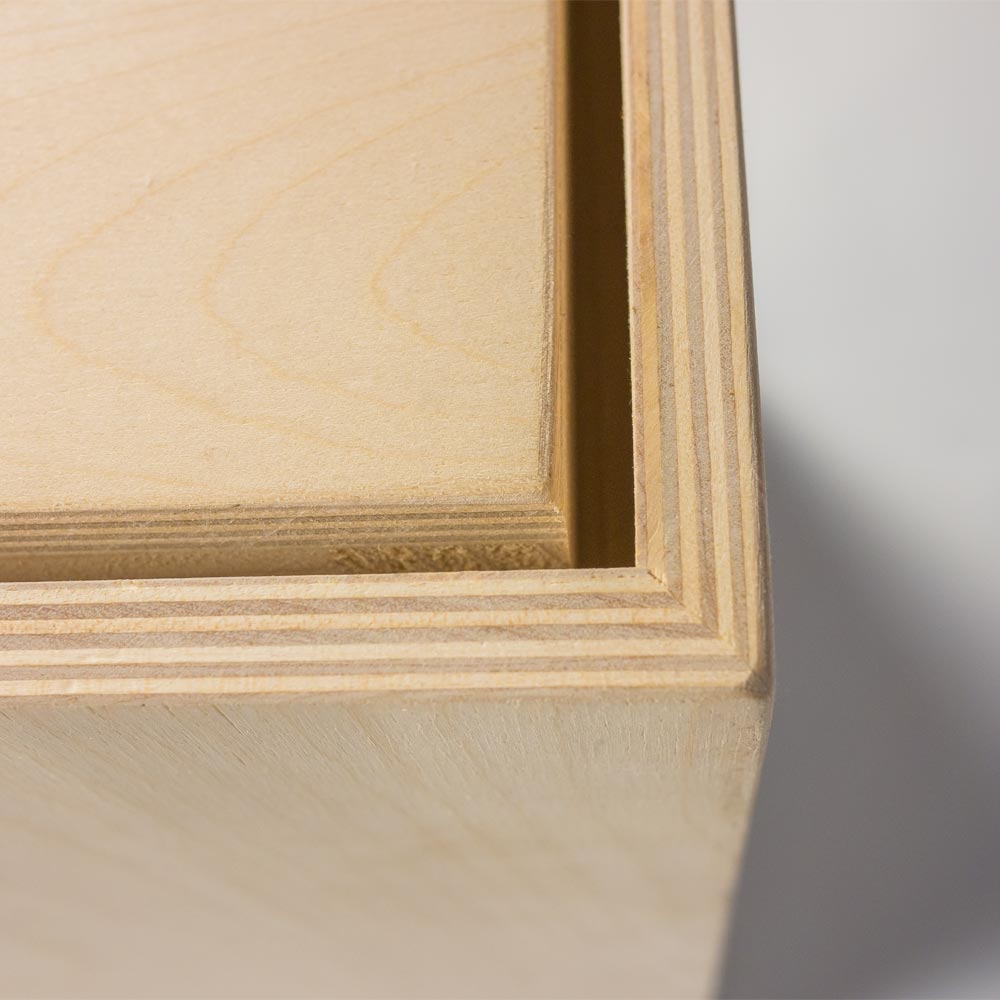
18 mm thirteen-ply top on a full-perimeter frame ring — sag capped at L/360, so vitrines sit true.
It takes real weight.
We've stacked over 2,000 lbs on one without a failure; every size is rated with a 2× margin, and the heavy-duty build doubles it.
It's safe next to artifacts.
Optional second top wrapped in Oddy-tested fabric — the museum screening standard.
It lasts.
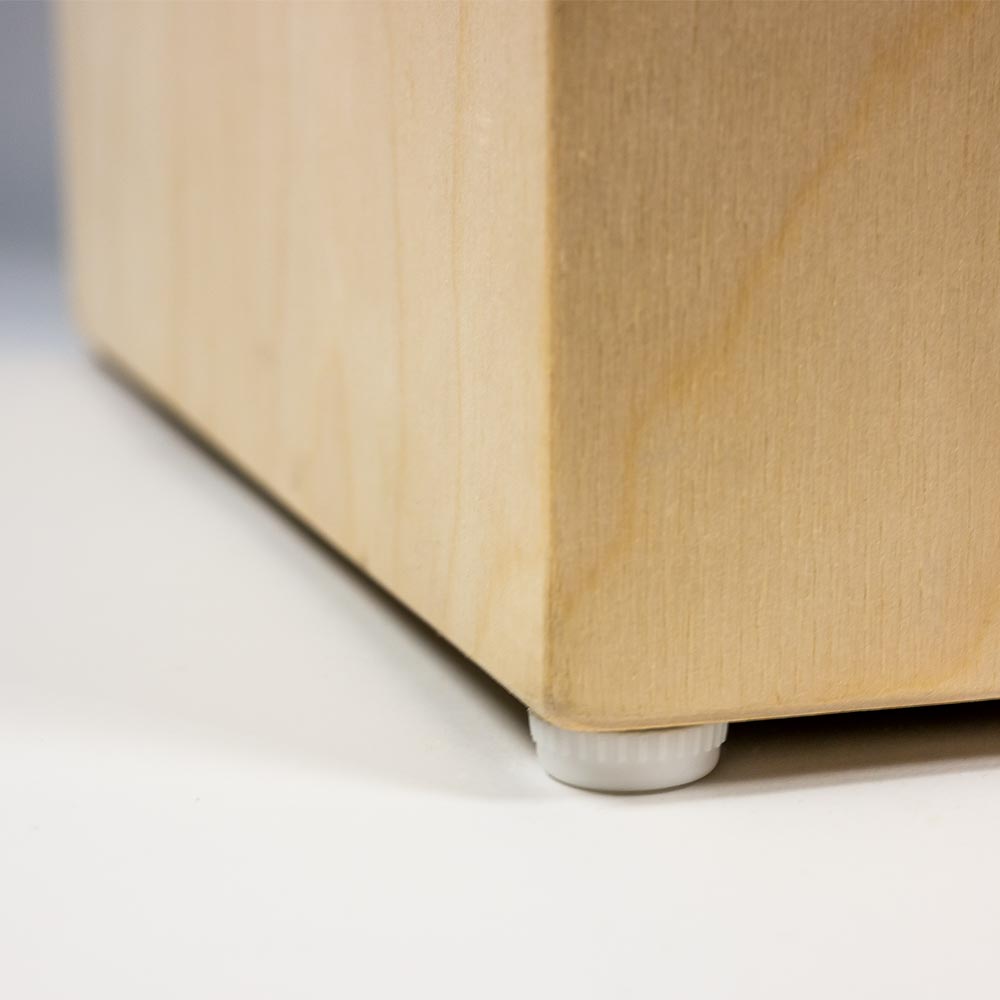
No particleboard to swell at the first hint of water, no laminate to peel. Replaceable feet, vitrines added years later — in service all across North America.
Top styles
SECTIONS AT TOP EDGE · VITRINE IN GREY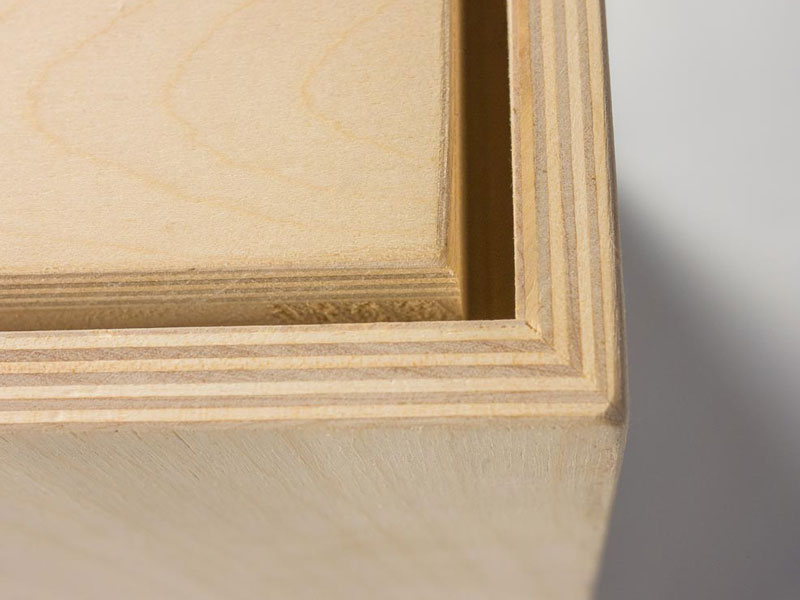
Groove MOST POPULAR
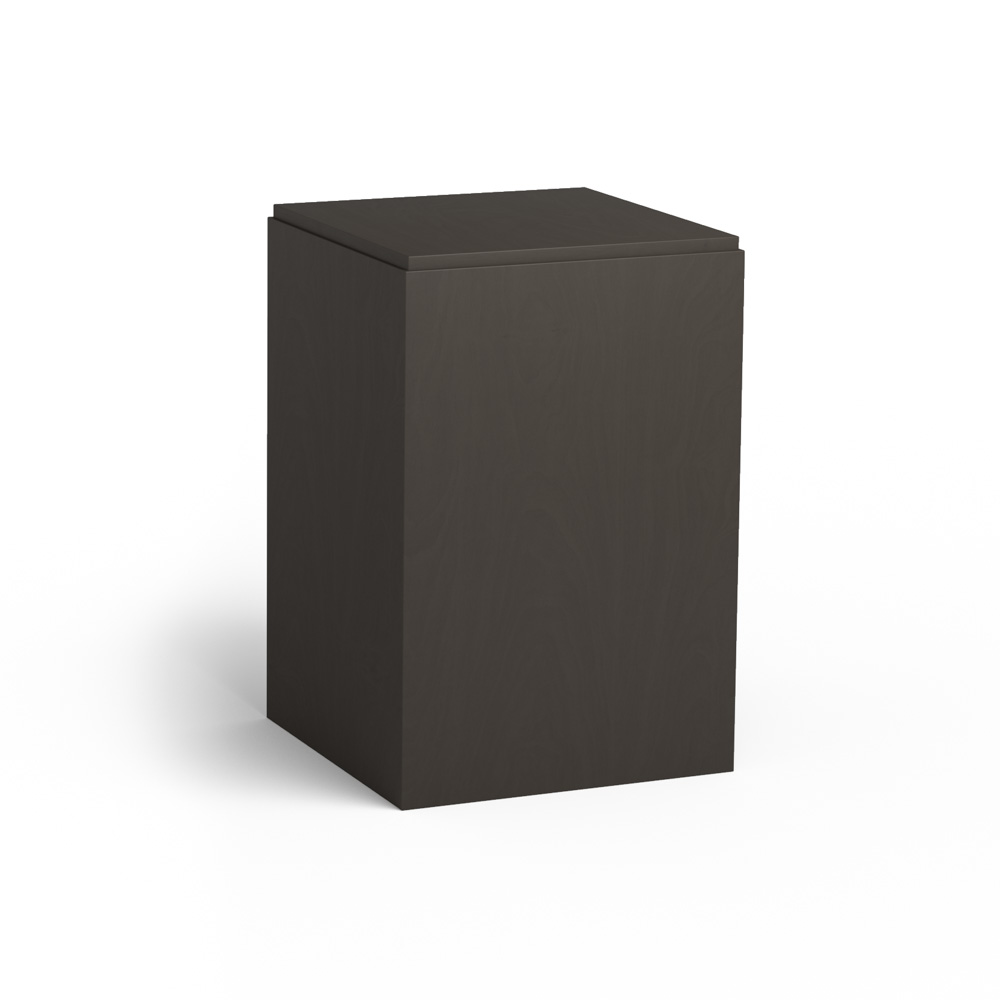
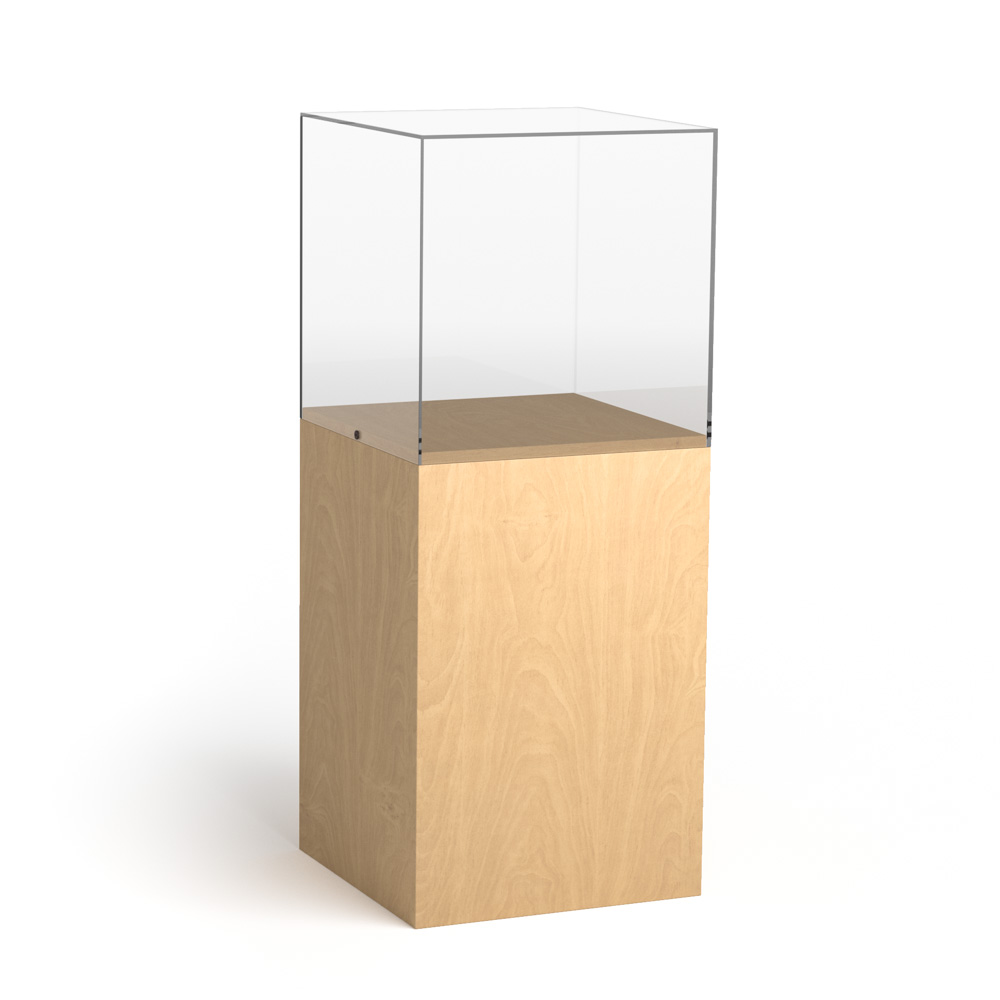
Our most popular pedestal, by far. The walls run past the inset top and the vitrine drops into the groove between them — and because the bare top reads finished, it works beautifully with or without the vitrine. A hidden set screw, behind a small hole in the side, locks the vitrine with the same hex key.
Watch the vitrine lock
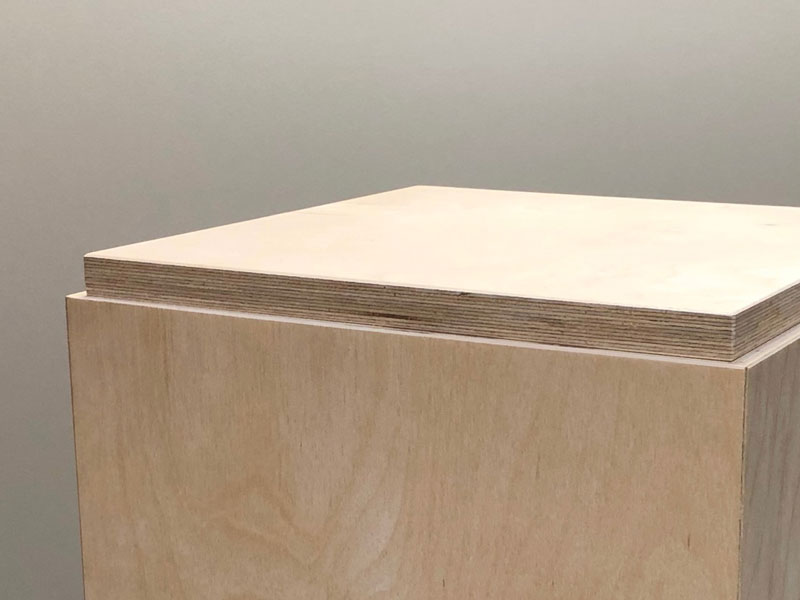
Step
The vitrine sits flush with the pedestal sides, over a raised step. Set screws lock it — a hex key opens it. The cleanest closed silhouette.
Watch the vitrine lock
Flat
A plain, dead-flat top for open display — or add the fabric-wrapped second top. No vitrine on this style.
Sizing
HEIGHTS VS. EYE LEVEL — STANDING AND SEATEDStep — interior vitrine clearance

Groove — interior vitrine clearance

The builder shows exterior and interior vitrine sizes live for any size you enter.
Capacity — how we rate it
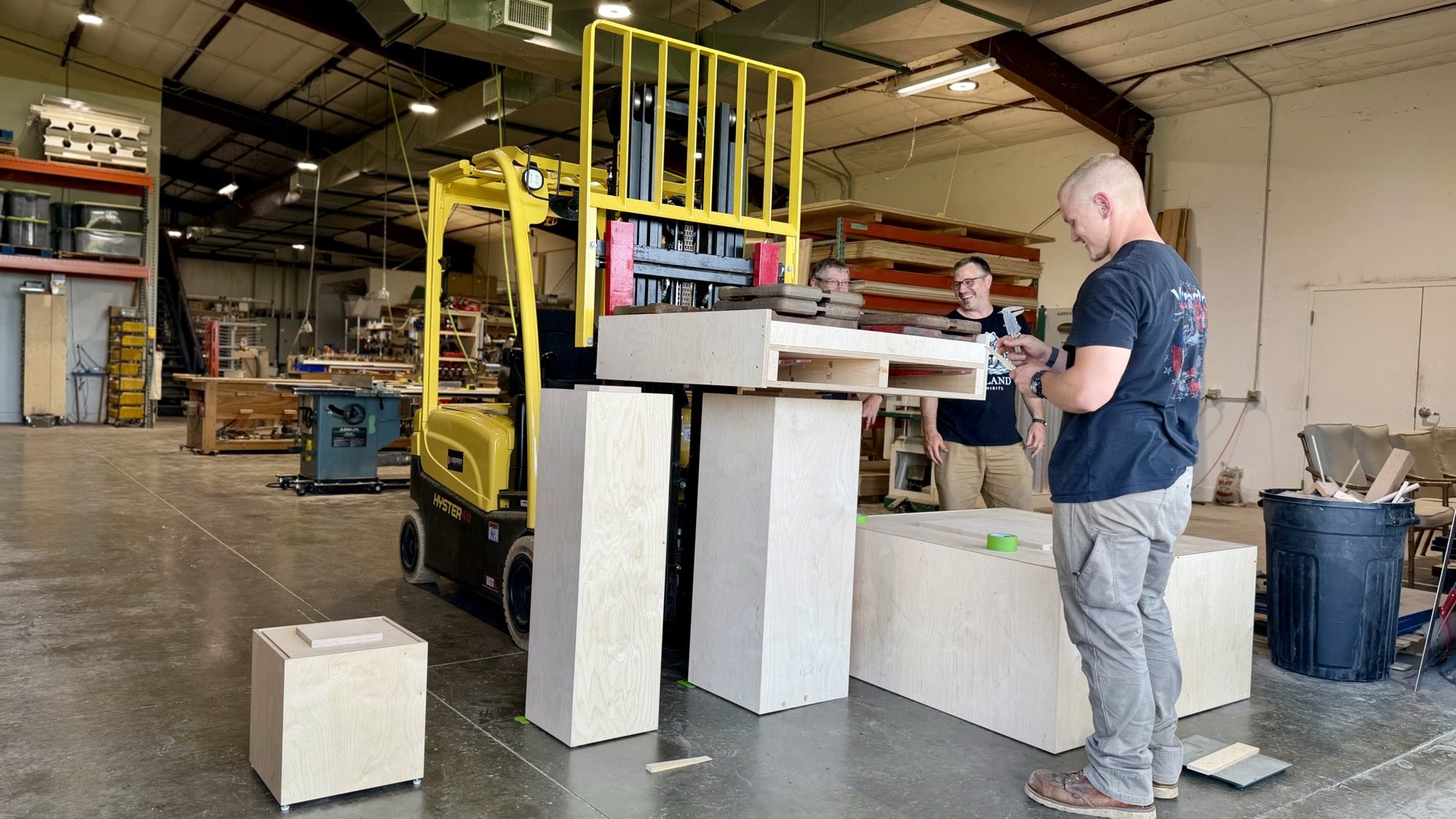
TESTED, NOT GUESSEDWe piled over 2,000 lbs on a pedestal without a failure. The rating starts far earlier — at the first hint of flex in the frame and feet, around 750 lbs.
The published rating is half that first-flex threshold — margin for real-world variation and off-center loads.
The number for your exact size appears in the builder above. The heavy-duty build doubles it.
We also cap top-panel sag at L/360 for every size, checked with classical plate mechanics — the full method, formulas and all, lives under the Capacity readout in the builder.
Finishes
ANY COLOR · INCLUDED IN THE PRICENatural birch
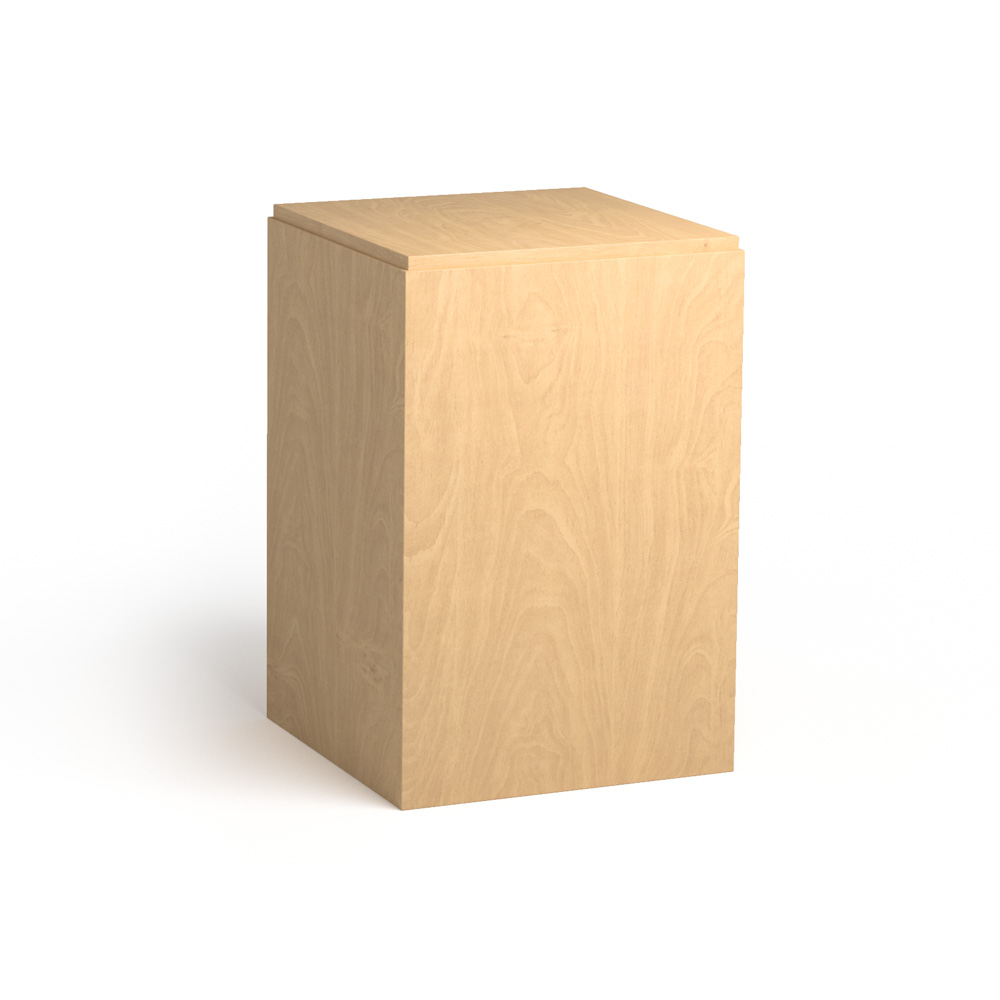
Clear water-based poly over the raw plies. The material, honestly.
American walnut stain
Warm and gallery-dark; the ply edge still reads at the corners.
White poly
Sprayed white with a whisper of grain in the sheen — clean, never plastic.
Black poly
Sprayed black, the grain ghosting through the sheen — like a lacquered piano.
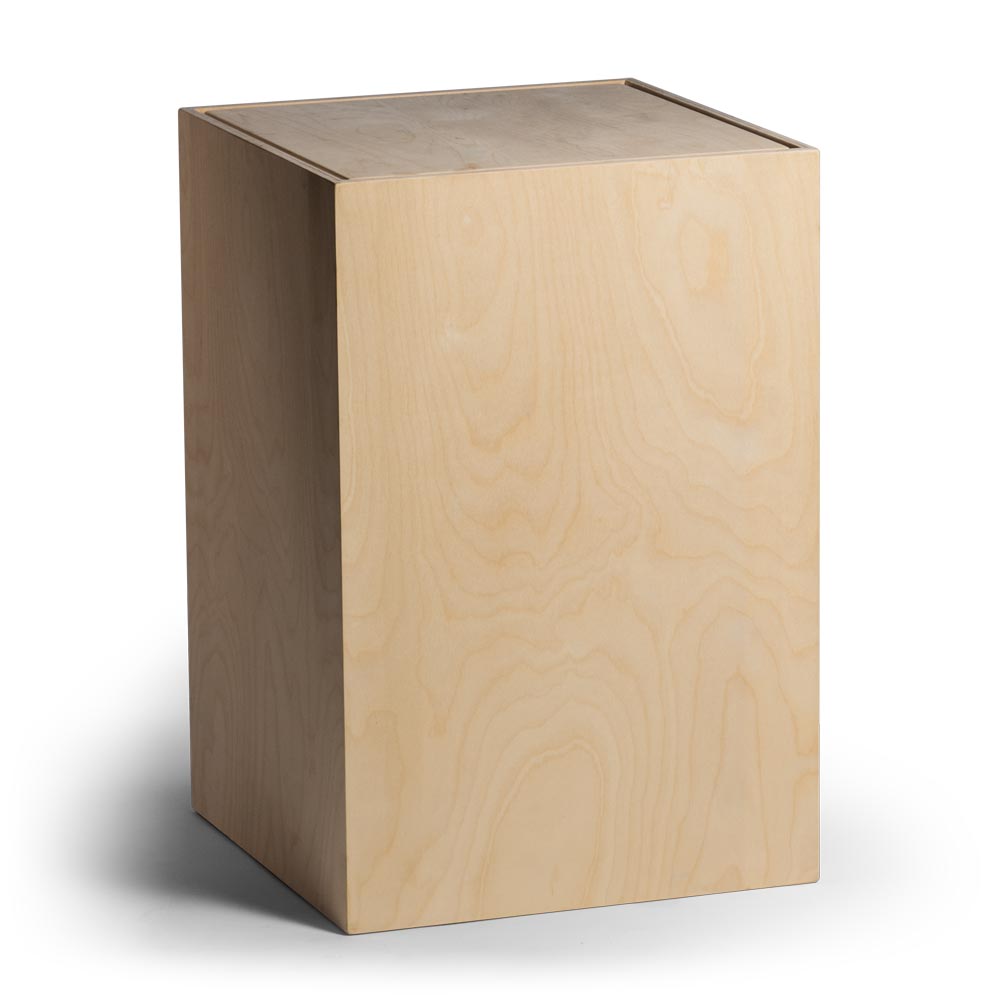
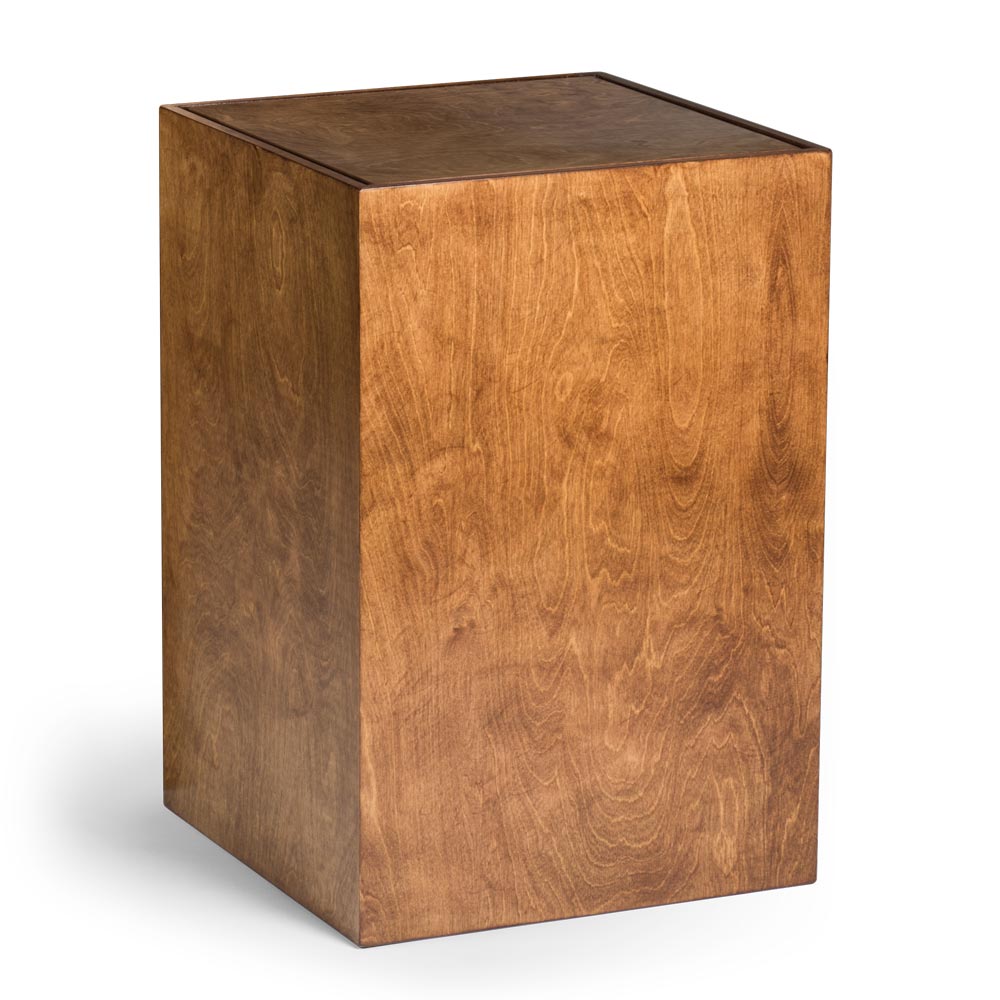
Need a specific color? Choose Custom in the builder and enter a Sherwin-Williams (preferred) or Benjamin Moore color code, or an Old Masters stain. Every painted or stained pedestal gets a clear satin polycrylic topcoat.
Shop & shipping
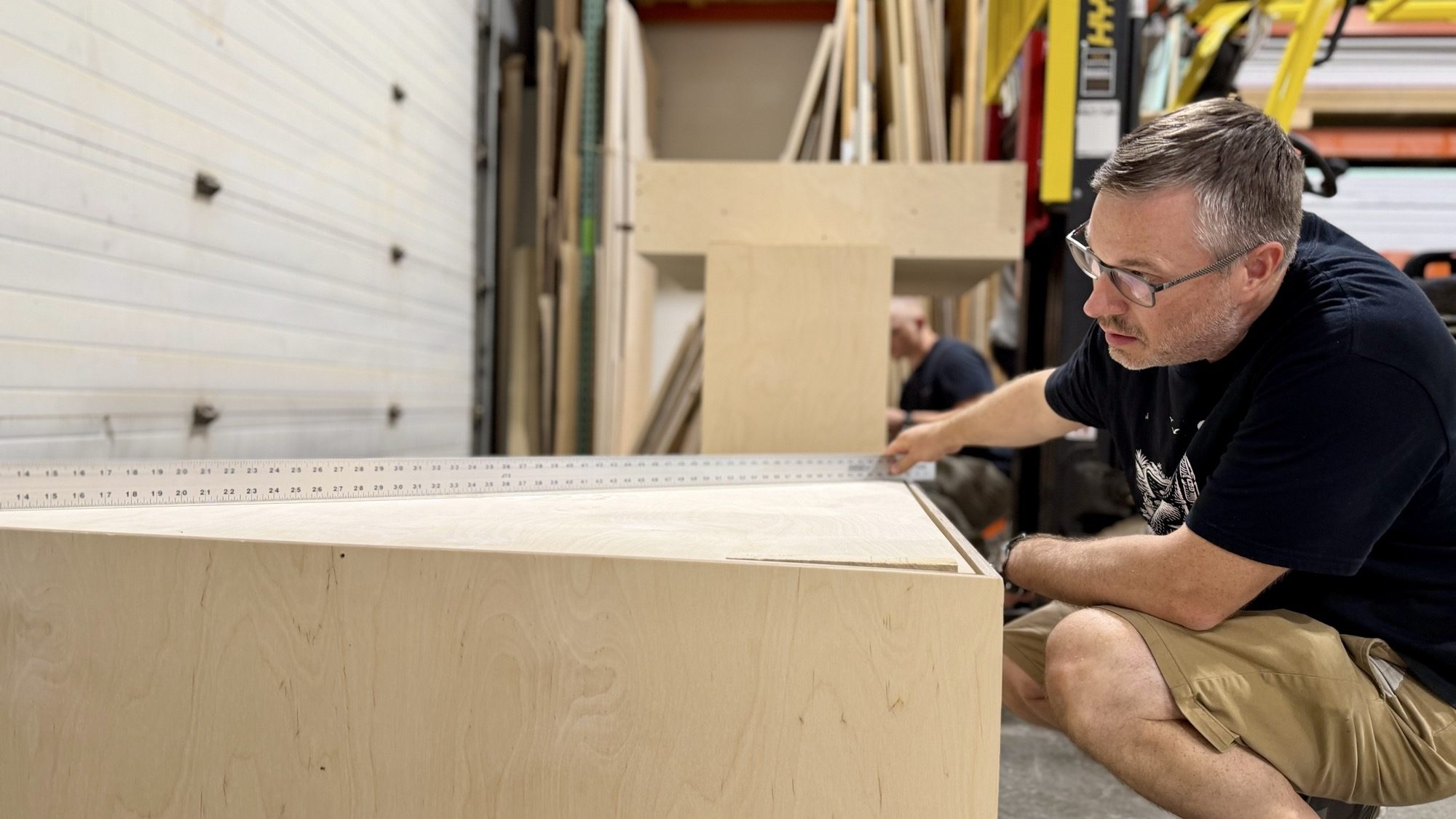
NEWTON, KANSAS · BUILT TO ORDEREvery pedestal is cut, assembled, and finished in our shop in Newton, Kansas — by people who build full museum exhibits for a living. Pedestals aren't a side product we outsource; they're the same casework, distilled.
For your home, too. We happily build a single pedestal for a living room, a lobby, or one very good object.
- Production
- 3 weeks typical; 4 with a fabric-wrapped top. Ship-by date shows before checkout.
- Transit
- 3–5 days. FedEx Ground for smaller sizes; larger and multi-unit orders go LTL freight, crated.
- Arrival
- Finished, assembled, ready to level and load — hardware bag included.
- Sets
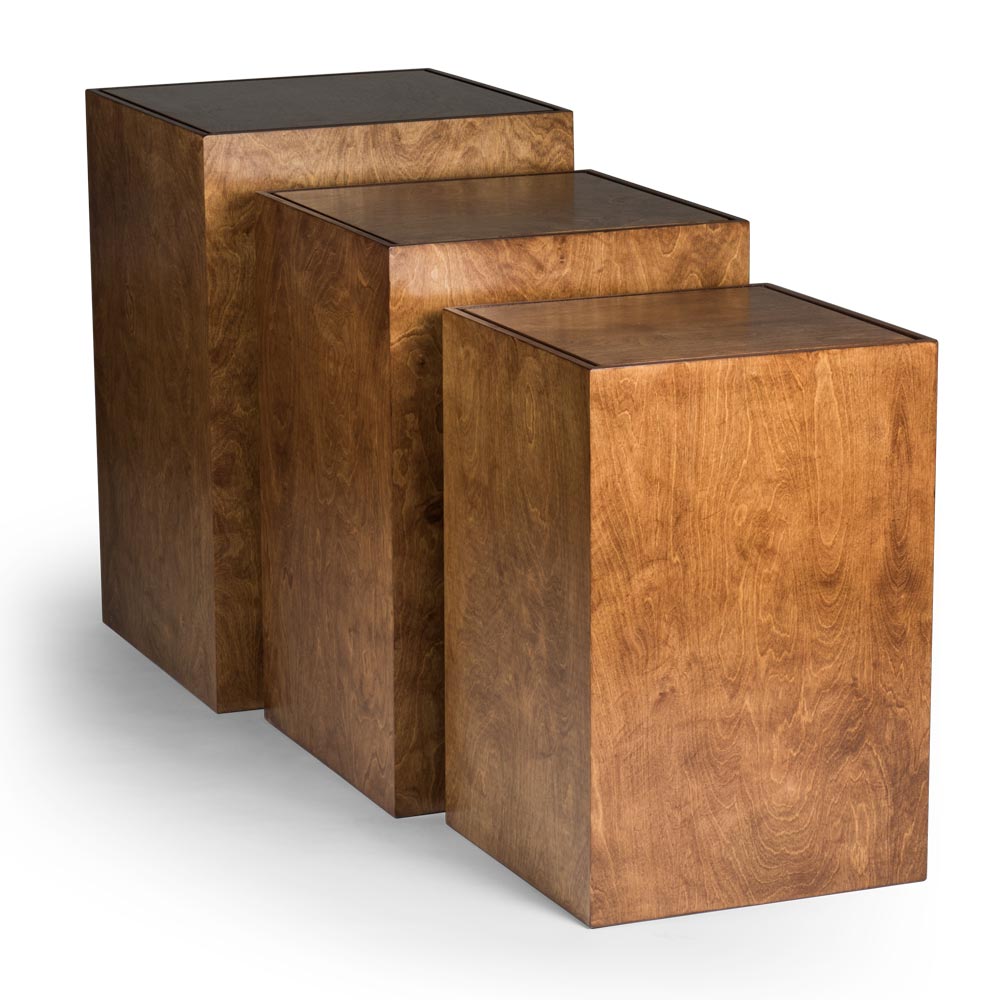
- Nesting sets that store inside each other — see nesting pedestals.
In the field
TAP ANY PHOTO TO ENLARGE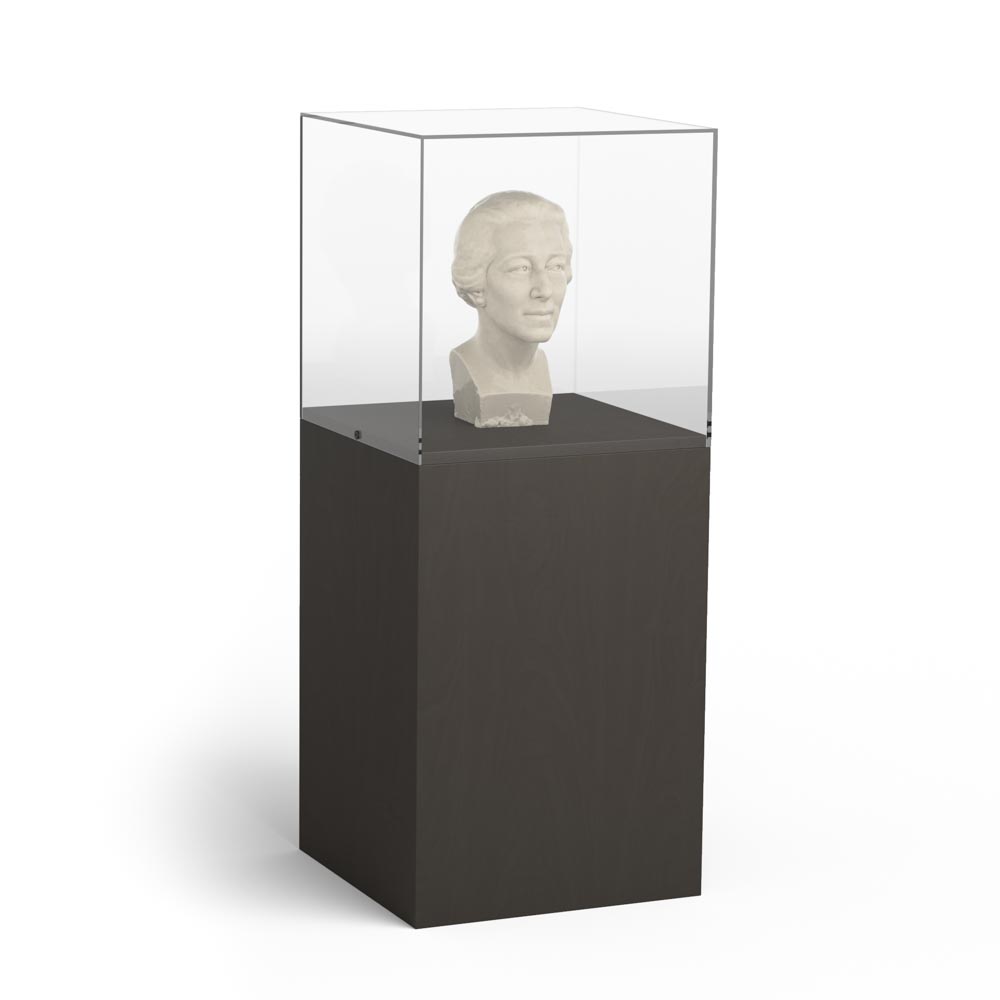
Common questions
MORE AT /FAQ/What weight will a pedestal hold?
Every size shows a weight rating right in the pedestal builder — for most sizes it lands between roughly 250 and 380 lbs for a centered object. The limit comes from the lower frame and leveler feet, which we load-test in our shop and rate with a 2x safety margin. We've stacked over 2,000 lbs on a pedestal without a failure — see how we test and rate them. For heavier artifacts, choose the heavy-duty build in the builder: uprated internal frames, feet, and top supports that double the weight rating.
Can I add a vitrine later to a pedestal I already own?
Yes, if we built the pedestal originally. Send us your original quote or order reference plus the vitrine dimensions you need and we'll build one to match.
What is the fabric-wrapped top option?
A second baltic birch top wrapped in an Oddy-tested performance fabric. The Oddy test is the museum standard for screening materials that sit near sensitive artifacts, so the wrapped top gives you a soft, conservation-conscious display surface. We'll confirm the fabric color with you after checkout.
Can I pick a specific paint or stain color?
Yes — choose Custom in the builder and enter a Sherwin-Williams (preferred) or Benjamin Moore color code, or an Old Masters stain. Custom colors are included in the price, and every painted or stained pedestal gets a clear satin polycrylic topcoat.
How does the vitrine attach?
Step vitrines slip over the raised step and lock with set screws through the vitrine wall. Groove vitrines drop into the groove and lock with a hidden set screw, reached through a small hole in the side of the pedestal. Either way, one hex key locks and releases it.
When will it arrive?
Pedestals are built to order in about 3 weeks (4 with a fabric-wrapped top), then spend 3–5 days in transit. The builder shows a ship-by date for your exact configuration before checkout.